Published · Scientific Reports
ISPAT
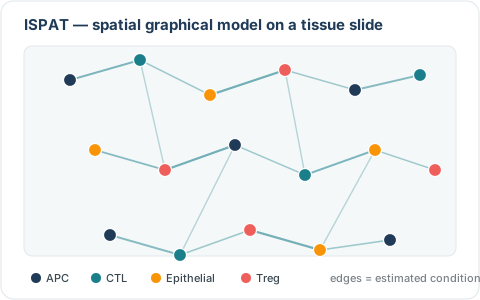
Informed spatially aware patterns for multiplexed immunofluorescence data.
Research Associate · Penn Medicine
I develop Bayesian statistical methods, machine-learning models, and bioinformatic pipelines for clinical trials, biomedical phenotyping, molecular cohorts, and high-dimensional spatial data.

Current focus
Bayesian trial design & biomedical phenotyping
What I do
I am a Research Associate in the Department of Biostatistics, Epidemiology and Informatics at Penn Medicine and the University of Pennsylvania. I work with Michael Harhay, PhD, and colleagues in the Center for Clinical Trials Innovation and the Palliative and Advanced Illness Research (PAIR) Center.
My current work spans ARDS, pneumonia, and sepsis phenotyping; molecular cohort studies; and Bayesian early-phase trial design. I bring to these problems a foundation in Bayesian variable selection, graphical models, and spatial methods for high-dimensional biomedical data.
Previously, I was a Postdoctoral Research Fellow at the University of Michigan, where I worked with Arvind Rao, PhD. I earned my PhD in Biostatistics from the University of Louisville in 2022 under Jeremy Gaskins, PhD, and the late Riten Mitra, PhD.
Flagship research software
The Spatial Methods Workbench turns a growing statistical methods program into a guided analysis platform. Twelve executable paths span 2D and 3D networks, spatial AI and machine learning, high-dimensional image regression, prediction, causal analysis, and tumor shape—each with compatibility checks and a complete provenance bundle.
Funding acknowledgement
Research reported in this software was supported by the National Cancer Institute of the National Institutes of Health under Award Number R37CA214955-01A1. The content is solely the responsibility of the author and does not necessarily represent the official views of the National Institutes of Health.
Research themes
High-dimensional network estimation with horseshoe and spike-and-slab priors.
02Cell–cell interaction networks in 2D and 3D multiplexed tissue imaging.
03Fusing histopathology, transcriptomics, and radiomics into coherent models.
04Mediation, sensitivity analysis, and interpretable functional biomarkers.
Selected work
Published · Scientific Reports
Informed spatially aware patterns for multiplexed immunofluorescence data.
Preprint · 3D imaging
Spatially varying conditional volumetric network estimation for three-dimensional tumor imaging.
Read preprintOpen-source methods
Reproducible implementations spanning spatial graphs, causal inference, functional depth, and imaging genomics.
Explore GitHubData modalities
Let’s connect